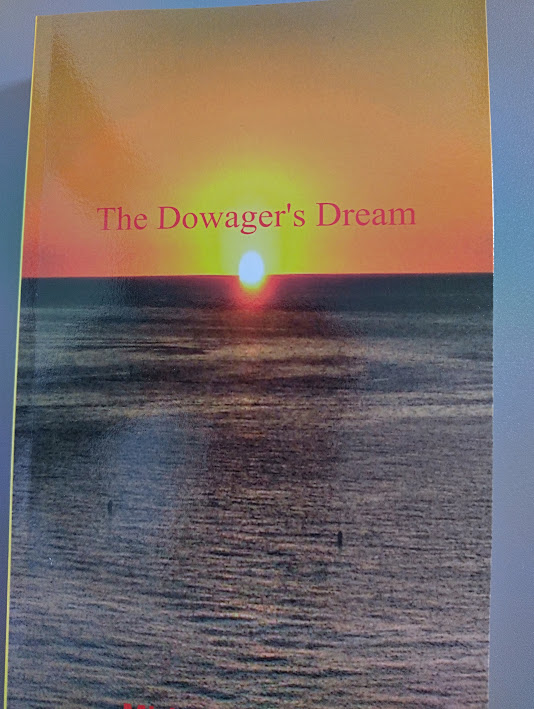
The Dowager’s Dream, Miriam Hastings’ latest novel, has been published in paperback by FeedARead Publishing. It’s also available as an ebook on Kindle: The Dowager’s Dream.
In a crumbling mansion on the north coast of Scotland, the Dowager grows old; exiled there by her son, the Laird, she dreams of her girlhood and waits for death, but when the tenants keep talking of a monster in the sea, she becomes obsessed with the strange creature living in the bay beyond her windows. The people claim the sea monster portends disaster and they are right for the Laird has grand plans to improve the estate. He intends to evict all the tenants from their crofts in order to turn the land over to an army of sheep. Can the Dowager stand up to her unscrupulous son? If she does, she may have to pay a terrible price.
Some reviews of The Dowager’s Dream:
Miriam Hastings’s historical novel The Dowager’s Dream is an absorbing tale – set during the early 19th century it tells of the devastating Highland clearances in the north of Scotland when the established norms of existence for local communities was upended by new farming methods and the introduction of ‘big white sheep’. These were introduced locally at the behest of the Laird, the elderly Dowager’s son living at the Big House. The women relate the events from their own perspective. Miss Mary, the daughter of the strict and intimidating local Minister and Kirsty, her feisty lady’s maid and servant provide a sympathetic and vivid picture of the times and the hardship for the local families relying on fishing and farming for their livelihood. The elderly Dowager, part of the old guard, becomes obsessed by the appearance of a mermaid found on the shore who might predict the coming upheaval in society which will destroy livelihoods and cause so many to go overseas for work.
I was thoroughly gripped by the story and enjoyed the ins and outs of the possible liaisons for Miss Mary with two of the main male characters which were handled by the author with such subtlety. Kirsty’s outspoken and down to earth attitude to events brings the story and the situation to life and I can thoroughly recommend this book. Genista Lewes, poet, author of Tightrope. 5/2/24
I was curious to read this book as I have enjoyed the author’s other works very much. However, I am not usually drawn to historical fiction so I was unsure. I am so glad I gave it a go as this is one of the best books I have read in a long time and it will stay with me for a long time to come. I had to write my review on the day I finished reading it, so that everything was fresh in my head and I could do it justice!
The story is told from two points of view – minister’s daughter Mary and her maid, Kirsty and the setting is the north of Scotland in the early years of the 19th century. Here, the ordinary folk work the land owned by the Laird of the estate, which he has left in the hands of his mother, the Dowager. People are happy for the most part. Life is tough but so are the people, who gather together to love and obey God under the stern and watchful eye of the minister, Mr Mackenzie. When Mary sees a mermaid, Kirsty believes it to be a bad omen, while the Dowager is as curious and enthralled as Mary. It seems Kirsty is right, however, when the ghastly spoilt Laird returns to announce grand changes. He has plans to evict the tenant farmers and fill his land with profitable sheep and he employs cruel and violent methods to dispose of the peasants, who are less then human primitives in his eyes. This is a story that is hard to sum up. It is brooding and atmospheric, the rugged Scottish highlands almost a character in their own right and it keeps a steady gentle pace that draws you in, comforts you and fills your mind and your heart. I became utterly immersed and lost in the world the author had created. I loved every character, especially the girls telling the story and felt as if I truly knew and understood them. I felt sorrow, anger and fear for the way the tenants were treated and I cheered them all on with every small, brave victory. The mermaid and also selkies are perfect mythical folklore stories woven into the fabric of this mesmerising story and they provided great joy to me as a reader. I was curious, I was involved, I was happy and sad and everything in between. This is a tale of rich people trampling all over poor people just to get even richer and that is something still very relevant today. I implore people to read this book. If you enjoy historical fiction you will love it, but if you enjoy character driven tales and folklore you will also appreciate it greatly. I will be thinking about this and I’m now enduring a true book hangover and missing it immensely! Chantelle Atkins (author), Goodreads.
Mermaids and their watery kin are always figures of fascination (and not only for children). Their magnetic pull can be contrary; mermaids can be objects of fear, or, archetypes of blissful enchantment. Often these ambivalent sea-creatures’ presence in literature is deeply frightening, as in Hans Andersen’s The Little Mermaid; but that tale’s much newer filmic version dampens down much of its original’s darker sides, perhaps suggesting that our contemporary society can’t come to terms with the shadows which haunt it. Recently, there’s the popular, ‘meet a mermaid’ scheme in which there are bewitching pop up mermaids emerging from sea’s depths all around our real coastline – their popularity lives on! It was thus with great interest that I began to turn the opening pages of Miriam Hastings’ latest novel, The Dowager’s Dream to discover that the book’s opening chapters feature a fantastical appearance of a mermaid who’s frozen in the ice of a frozen burn: ‘She was lying with her green hair cast about her like seaweed … her skin was as white as alabaster…’
I’m a great admirer of Hastings’s fiction so before beginning the book had already expected her latest novel to be a great read; but the mesmerising mermaid was a total surprise; her presence in the novel, a compelling hook, charms the reader swiftly into the fictional spell, introducing a magical, almost surreal, element to this richly layered, partly historical tale, which is saturated with breathtaking descriptions of the remote northern regions of Scotland during the time of the turbulent Highland Clearances.
So, at one level The Dowager’s Dream is a mermaid love story: but she comes with a (big) difference! According to the author’s own account posted in an interview the mermaid in The Dowager’s Dream is rooted in historical documentation, not unsubstantiated fantasy. Hastings’ vision was impelled by the magnetic pull of stories about the lives of her two Scots great grandmothers, foremothers born and brought up in those harsh northern edge lands, who left their descendants legends apropos their personal experiences during the crisis of the clearances. Such authenticity in her ancestral background means that the author has inherited an archetypal kindred spirit which allows her to suffuse her evocative settings with the landscapes’s local Genius Loci: its folklore, its faery (or magic-folk) traditions embedded within the region’s archaeological sites. In this wonderful novel mermaid herself is far more grounded than flighty figment of authorial imagination; her origins were apparently a real fragment from a contemporary newspaper story about such a creature spotted by Elizabeth, daughter of a local Minister, described in a letter she’d sent to a friend, then discovered again by Hastings reprinted in an encyclopaedia for children. Mermaid as icon of magic and mystery is accompanied in this fictional journey by other fantasy figures from the ‘Faery’ world, which, like mermaid, are similarly instigated by tales of northern Scottish mythology. There’s also a couple of appearances from a strangely exotic monkey creature (Meena), a liminal being perhaps reminiscent of Angela Carter’s mysteriously liminal animals.
As often with successful fiction inspired by authorial curiosity, The Dowager’s Dream, like a palimpsest, comprises fascinating interweaving layerings. Steeped in meticulously researched historical research, layered and combining in depth familiarity about the rugged scenery of the Scottish northern regions, with their typifying machair, their marram grass waving through the landscapes, ‘like the wind,’ along with considerable in-depth research into the intricacies of the historical contexts, the book’s narrative is told through the perspectives of two of its main characters. One is Mary, a minister’s daughter (who spots and becomes fascinated with the mermaid), and the other is Kirsty, who’s Mary’s servant and friend. Told through the visions of their complementary optics the young women’s stories unfold a compelling tale set against the background of the spectacular countryside as its inhabitants struggle with a crisis instigated by the local Laird, whose mother, the Dowager of the title, like Mary, is haunted by the mermaid. Mother and son’s relationship sadly has turned sour and is mired by dysfunction. A conflict arises between them concerning the plans of the Laird’s land agent to take over the locals’ lands lock stock and barrel, so that they can farm the Great White Sheep. A series of dramatic incidents occur climaxing in a final traumatic stand-off, in which with local support (especially that of the women), the Dowager stands up for and shows her loyalty to the threatened community, and her son is banished from his lands, receiving the punishment he’s long deserved.
Threaded through the eviction story which is packed with a cast of wonderfully portrayed characters, there’s a parallel narrative interweaving the unfurling of the two young women’s mutual love-stories: Mary is torn between the potent physicality of the newly appointed rogue land agent William Patterson, and the steadfast loyalties of new steward Malcom Frazer, whilst Kirsty responds to the temptations of new shepherd Thomas.
But back full circle to the iconic mermaid whose appearance bookends the novel and haunts Mary and the Dowager, who both long to be drawn into her psychic realm; their respective fates are intertwined and metamorphosed by their obsession with her. There are potentially various interpretations of the creature’s significance in the book. For Carl Jung a mermaid is a potent secret watery feminine archetype, sited between real and imaginary realms, whose significance is as agent of inner transformation. Such I believe is the sea creature’s complex purpose as dreamlike metaphor at this novel’s heart. Mermaid for me is in part a lyrical archetype who figures a lament for the lost local rural community as it is threatened by the forces which will change it forever. Beyond that, her presence and purpose is linked with Mary’s journey to love. It’s a love story developed and fulfilled after Mary encounters several startling transformative encounters, catharses, where psychically she ‘merges’ with the creature in a mutual transference: ‘I could no longer tell if I had become the mermaid or if the mermaid was me’. In Jungian terms Mary goes through an inner process of individuation, an alchemical crucible allowing acceptance of and integration of her shadow side; mermaid becomes emblem both of acceptance of repressed aspects of her personality and of sublimated eroticism. The Dowager’s experience of mermaid similarly describes a mutual blend of self with mermaid.
I was reminded of lyrical watery emblems in earlier feminist writers such as H.D. and Woolf, who both investigate how mermaid myths impact women, but Mary’s/the Dowager’s mermaid departs the novel with a distinctly deconstructive and ironic twist. As they both watch her following their final encounter with her, mermaid is not, as ‘in the old tales’, singing ‘enchantingly’, luring sailors to their deaths, but instead ‘gave out a strange cry … a cross between a bark of a seal and the scream of a gull… she opened her mouth wide to reveal teeth sharp and jagged like a shark’s’. Not only does the image destroy Mary’s projective fantasy of mermaid as blissful jouissance; but also perhaps, in the wider context of the novel’s historical story, mermaid (and faeries) remind the reader that this is not fairy-tale fiction with happy ever-after ending, but rather, a fiction portraying societal repression, holding a mirror up to grim reality, the complex background history and grim reality of nature, red in tooth and claw. For, as the story progresses, a reader will notice how this novel resonates with important themes of today, presenting sinister parallels with several of the biggest issues of contemporary times. Dispossession. Movement of peoples. Homelessness.
Before I finish, I must just note here how skilful Hastings is in selecting felicitous and deceptively simple imagery. For example, similes such as the following – which describes the Dowager – whose skirts as she whirls around a dance floor are ‘like some great bat’s wings floating above her.’ Or, there’s ’the cold and the isolation [which] have eaten at my lady’s wits like moths at a blanket’. Skilful touches showing we are in the hands of a gifted writer whose craft matches her vision. The enduring recollection I’ll have of The Dowager’s Dream is the way its author’s imagination and skill has come together to create a novel which balances a delicate line between fantasy/reality – a marvellous tale infused with more than a sprinkle of magical realism yet grounded with a backdrop chronicling the cruel fates of crucial historical facts. Dr Julie Sampson, Goodreads.
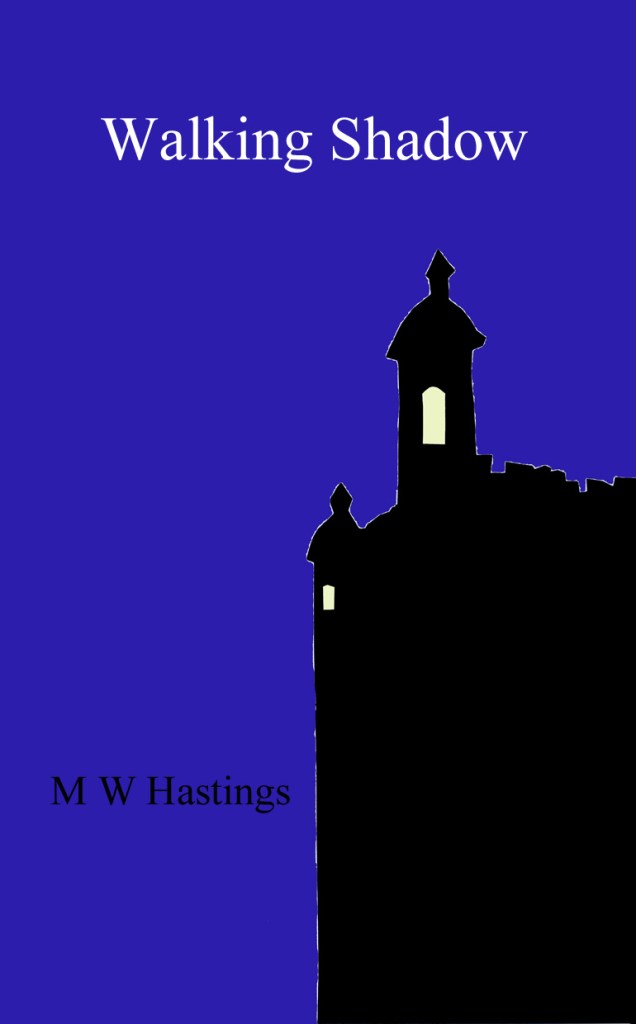
Walking Shadow, Miriam’s first historical novel, was published in November 2019 under the name of M W Hastings, and is available direct from FeedaRead Books as well as through Amazon. It is also available on Kindle.
Some Reviews:
It’s very clear from reading this intelligent and authentic historical novel that Miriam Hastings has a love of this period and has thoroughly researched it for Walking Shadow.
It’s London 1606 and Edmund Shakespeare, younger brother of William is taken to a dungeon beneath the Tower of London to be questioned regarding a plot to kill the King and his entire family.
For Edmund, one of the Lord Chamberlain’s Men (later known as the King’s Men), acting in plays such as Richard II are all grist to the mill for his interrogators: ‘…it’s a deliberate and treasonous act to show the crime of regicide.’
Edmund also gets to play female roles because he is young and ’pretty’. This gender fluidity, as well as the masks and disguises he and others adopt are a big theme of the book, where many of the characters are not quite what they seem.
The book is divided into parts each named after a quote from a play or sonnet of Shakespeare’s.
Miriam Hastings brings this period to terrifying life with her portrayal of real and fictional characters living cheek by jowl as they play out side by side in a world of brothels, Catholic persecution, treachery, debauchery, the plague, the gunpowder plot and torture. The dialect and expressions are totally authentic and spot on.
The narrative skilfully weaves between Edmund’s brutal interrogations in the stinking dungeon and what led him here. As one of the King’s Men he encounters members of royalty and the nobility, and others he has great affection for: Roland ‘the Fool’ and Kate.
‘For as Kate walked across the tavern, swaying slightly, her swelling womb held before her like a swan’s breast, she looked like a great bellied, white-sailed ship, dignified and beautiful.’
There’s a growing sense of foreboding and suspense as Edmund becomes embroiled delivering letters to help the Jesuit priest escape to France. The moments of love and loss are at times heart-breaking.
The plague and pestilence and the impact on their lives is eerily relevant with our twenty first century equivalent happening internationally in the form of the coronavirus. Meg of the tavern repeats conspiracy theories that the place is ‘part of a Papist plot’. Genius! That whole scene in the tavern, as so many others in the book, is rich with colourful metaphors and characters.
I’ve not read any of Hilary Mantel’s Wolf Hall trilogy but I’m pretty certain that lovers of Mantel’s work would really go for this intriguing and unique novel. Highly recommended. Kate Rigby (author), Goodreads.
A Tale of Medieval Intrigue. The narrator is Edmund Shakespeare, William Shakespeare’s brother and actor/player, who partakes of the female roles in his brother’s plays, as per tradition then. It is narrated in the first person, which makes the narrative direct and personal. The author clearly knows her history well, for it is a faithful account of the historical times of the seventeenth century. However, this vast background knowledge does not intrude into the easy, simple narrative flow and the style is sparse and economical.
It is a fascinating tale of treachery, backstabbing, plots and skullduggery, because of course then, there was no such thing as human rights, and the law revolved around the Kings and Queens and their court, so one was very much on your own. Add to the mix the medieval struggles for hegemony between the Roman church and the reformers, with the consequent persecution of priests, monks and monasteries throughout England, and being a practising catholic punishable by death, we see much determination and resistance to bringing back the old order in the paranoia of the new order, ever hypervigilant of possible and actual traitors in their midst, and we have a wonderful recipe for a novel as thrilling as any modern tale of espionage and intrigue.
Young Edmund is a go-between of all these lofty characters that people the world of Shakespeare, who earned his living as a wordsmith playwright for the monarchy and aristocrats of his day. Thus, we have the outsider’s eye of events as the narrator is rapidly caught up in events that overtake him, after a foiled plot to overthrow the King. He tells his tale from the vantage point of looking back on how he reached the opening point of being under arrest in a dungeon and subjected to torture. It keeps the reader turning the page to find out more and who it was who betrayed him. Who dunnit?
The characters are based on a mixture of real people and fictitious characters and one was so cleverly named, I thought he was real. Thankfully, the author provides a glossary at the end of who is fictitious and who not (no peeking) which saved me looking it up for myself.
What gives the novel true originality is the ambiguity of Edmund’s gender and sexual identity because of course, in Shakespeare’s day, females in the theatre were considered prostitutes and thus all respectable plays were performed by males in female roles, who invariably had to be boyish in physique and mannerisms to succeed. As an aside, Shakespeare considered females to be ‘white’ whilst men were ‘brown’. So we can picture just how androgynous Edmund would have had to have been to play his part well. Comedy arises when he is avidly pursued by amorous dukes and lords, together with doses of Chaucerian bawdiness thrown in.
I was intrigued to note that Miriam Hastings got the idea for the main character from a tombstone of Shakespeare’s unknown sibling and has constructed Edmund’s imaginary life as a co-partner of William with great skill and insight. Mauve Peace.
Whether she is writing from the point of view of a patient in a mental hospital (as in her novel The Minotaur Hunt), a child in foster care (in her short story ‘The Doll’), or a minister’s daughter living on the north coast of Scotland in the early 19th century (her short story ‘Mermaid on Ice’), Miriam Hastings is always concerned with portraying the experience of the outsider in society; giving a voice to the powerless and the oppressed.
Miriam’s first novel,The Minotaur Hunt, was originally published by the Harvester Press, it was shortlisted for the Betty Trask Award and won the MIND Book of the Year Award. Sadly, soon after publication Harvester were taken over by Simon & Schuster who closed their fiction list and so the hardback edition of the novel is now out of print, although it’s often available secondhand from amazon and other online stores. A freshly revised digital edition with a new afterword is now available on Kindle (The Minotaur Hunt) and Kobo (The Minotaur Hunt), and a paperback edition has also been published.
Three surreal tales by Miriam Hastings are available on Kindle: The Doll and other stories: Strange tales. Also on Kobo: The Doll and other stories: Strange Tales
 Miriam Hastings, author